T9 Class, No.120
Built August 1899
Dugald Drummond
Class Introduction
T9 No.120 was outshopped from Nine Elms locomotive works in August 1899. Resplendent in LSWR Drummond passenger green, 120 was built at a cost of £2271. The class were affectionately nicknamed ‘Greyhounds’ due to the quick turn of speed that they could achieve. This attribute was one of the main reasons why they were assigned to the Waterloo – Exeter route following their release into service. All T9’s were originally built as saturated engines as the development of superheating was not introduced to British steam until the early 1900’s. These boilers were known to be free steaming and the saturated boiler design gave 120 a very distinctive front-end look, not too dis-similar to that of 563. 120 was part of the first batch of T9’s released into traffic and carried a ‘conventional’ firebox/boiler design, unlike the T9’s built by Dubs & Co which incorporated cross water tubes in their fireboxes. An arrangement that was subsequently taken forward for all future Drummond designed engines until his death in 1912, although at extra expense and design complexity.
Being part of the original series of T9’s constructed, 120 carries the narrow cab and wheel splasher design with separate coupling rod splashers, one of the more unusual features of the class. Out of the sixty-six constructed, fifty-one carried this style. Only fifteen built at Nine Elms in 1901 carried the wider cab and wheel splasher designed which covered the wheels as well as the ‘throw’ of the coupling rods within.
120 was originally constructed with a six-wheel tender and it was not until the 1901 series of T9’s that the eight-wheel water-cart tender which 120 has today were introduced. 120 had to wait until May of 1907 to receive her own. Water cart tenders allowed for longer running which must have been of large benefit on the long runs to and from the west country.
Such was the success of the design that few changes were made to the class until the early 1920’s. The successor to Drummond, Robert Urie as the LWSR’s Chief Mechanical Engineer began the task of ‘rebuilding’ the T9’s to incorporate more ‘modern’ features such as superheaters, larger bore cylinders,
fitting of a stove pipe chimney and the removal of the cross-water tube firebox design. These changes began in 1922 and continued post grouping into the Southern Railway in 1923 when Richard Maunsell became the Chief Mechanical Engineer. Notably, 120 was one of twenty-six T9’s that were repainted into Maunsell green Southern Livery (Olive) before being modified. 120 was painted into this livery in June 1925, but had to wait until May of 1927 to receive her modifications. Additional changes included removal of the prominent sandboxes on the leading driving axle to a subtler arrangement between the frames. As 120 received superheaters at this time, it also received the larger smokebox in order to carry the superheater header thus vastly changing the original looks of the engine to a design that it almost identical to her appearance today.
These modifications almost certainly increased the life of the T9’s. This was evidenced by the class continuing to find work between Salisbury and the West country on express passenger services, despite new and larger designs being introduced that should have usurped them.
The final modification, pre-World War two was the removal of the ‘E’ prefix from the primrose yellow lettering/numbering on the tender. There were 3 different letters used and these denoted the region that the locomotive was based in. ‘E’ being Western section engines, ‘A’ for Eastern section engines and central section locomotives were branded with ‘B’. Post removal of this lettering, it is this livery that 120 is planned wear when she returns to service after the next overhaul.
Details
| Class Built | 1899–1901 |
| Total Built | 66 |
| Cylinders | Inside pair, 19 in × 26 in |
| Wheel Arrangement | 4‑4‑0 |
| Bogie Wheels | 3 ft 7 in |
| Driving Wheels | 6 ft 7 in |
| Tractive Effort | 17,670 lbf (78.60 kN) |
| Boiler Pressure | 175 psi |
| Firebox Grate | 24 sq. ft |
| Engine Weight | 51 tons |
| Tender Weight | 39 tons |
| Total Locomotive Weight | 90 tons |
| Total Locomotive Length | 63 ft 9 in |
| Water Capacity | 4000 gallons |
| Coal Capacity | 5 tons |

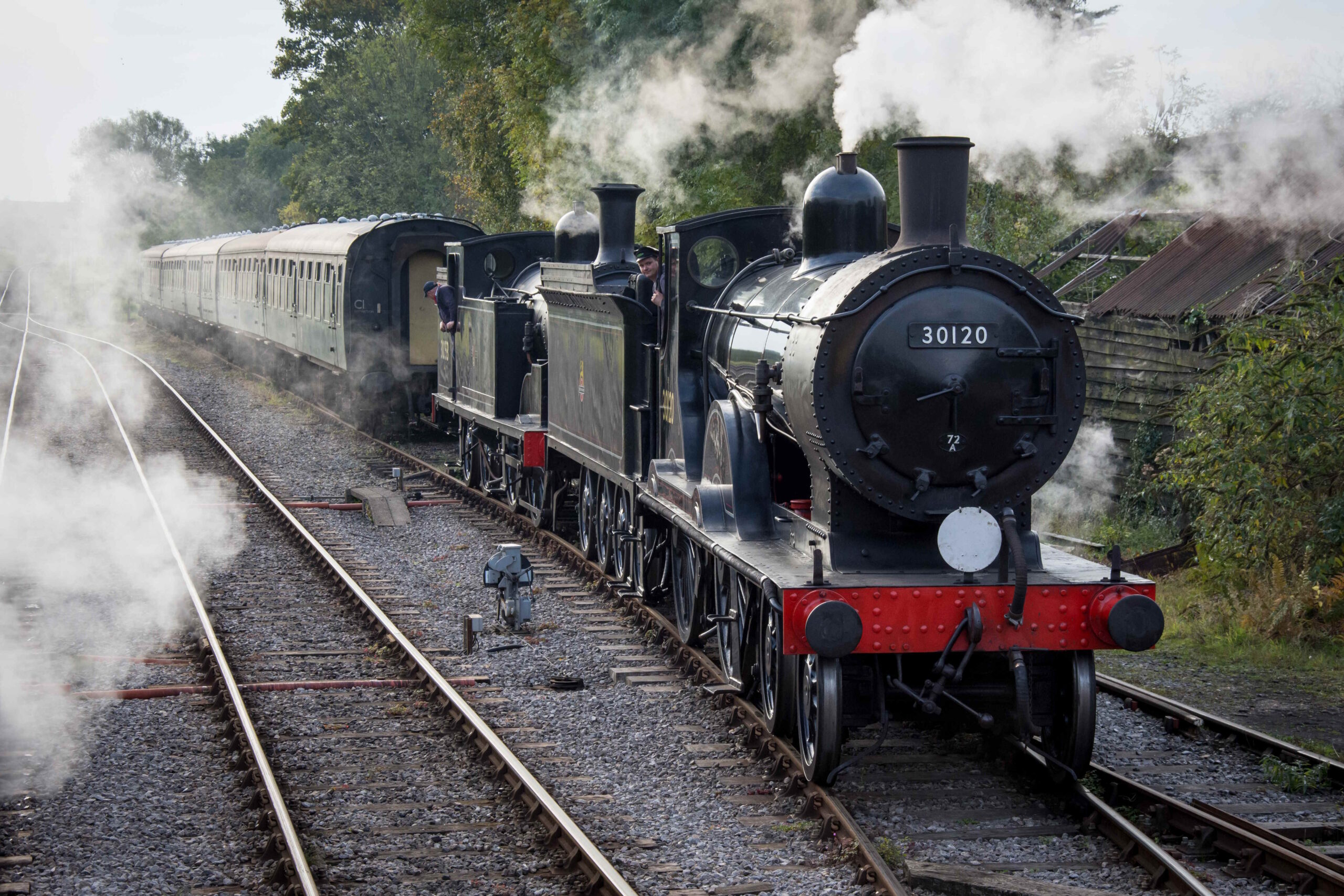
A Wartime Close Call – The 1942 Attack on No. 30120
In November 1942, 30120 was the subject of an attack by two Messerschmitt ME 109 fighter planes, whilst working an ammunition train between Brockenhurst and Dorchester. The locomotive was stopped at Wool when it was shot at by the German aircraft in broad daylight, which were returning to their base after an assault. Amazingly the munitions in the train were not compromised, however the locomotive suffered several areas of damage, including a hole in the cab roof where a shot entered the cab. Both of the crew were Dorchester men and were taken to the military hospital at Bovington for emergency medical treatment. The driver Harry Clark never returned to the footpate after the incident, but his Fireman Doug Keegan did. Harry and Doug’s story is passionately retold by Swanage Railway Driver Russ Ferrett, who’s father Fred was their colleague at Dorchester shed. The hole in 120s cab roof can still be seen today, and it’s preservation acts as a harrowing reminder of how lucky the crew were that day, and also of how fortunate we are to be able to retell the locomotive’s story in the 21st century.

Withdrawal and Preservation
The By the early 1960s, British Railways was rapidly phasing out older pre‑grouping express locomotives, and the once‑proud ranks of Drummond’s “Greyhounds” had thinned dramatically. Despite the arrival of newer and more powerful designs, T9 No.120 continued to prove its reliability and was among the last of the class to remain in traffic. The T9s were withdrawn between 1951 and 1963, with No.120 becoming the final survivor, marking the end of service for the entire class.
After its withdrawal, No.120 avoided the fate of scrapping thanks to its selection for preservation as the sole representative of the T9 class. It was acquired by the National Railway Museum, ensuring its survival as a significant example of Drummond’s express passenger design. For many years it remained part of the National Collection, later operating in preservation after being restored to running condition. No.120 steamed again during the preservation era, including periods on the Mid‑Hants Railway and later the Swanage Railway, before eventually being withdrawn once more when its boiler certificate expired.
Today, the locomotive stands as an invaluable and unique survivor, representing both Drummond’s engineering skill and the wider story of LSWR express steam. Its preservation journey continues under the care of the Swanage Railway Trust and the 563 Locomotive Group through Project 120, which aims to return this last “Greyhound” to steam once again.
 Photo courtesy of Andrew P.M. Wright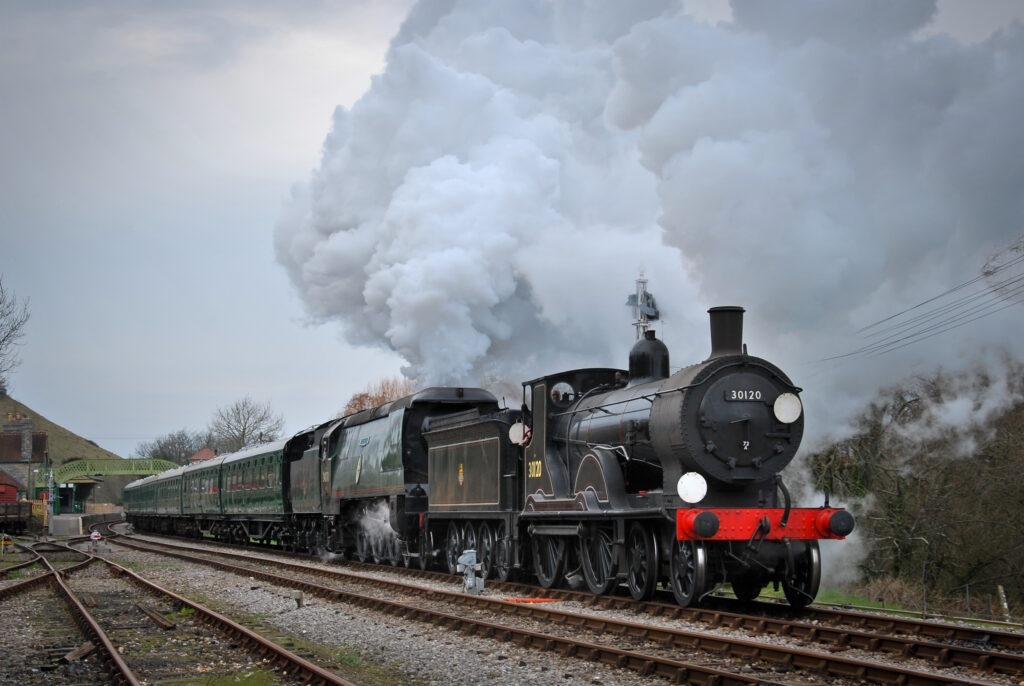
- Photo courtesy of Andrew P.M. Wright
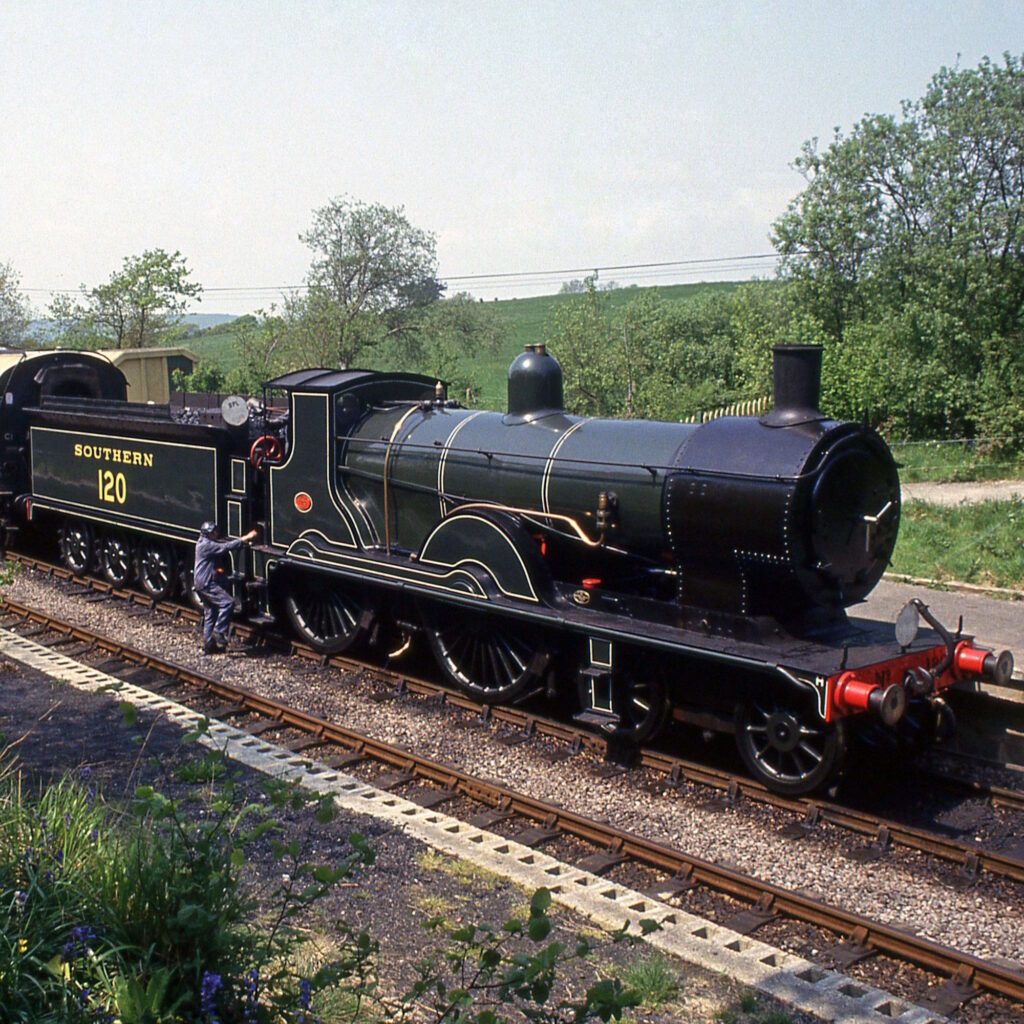 Photo courtesy of Andrew P.M. Wright